Professionalizing your club without losing its soul
For a long time, many martial arts clubs ran almost entirely on passion.
A municipal hall, a few slots lent by the town, dedicated volunteers, and above all a desire to pass on knowledge.
But over time, expectations evolve.
Students want more consistency, better communication, simpler sign-ups, online payments, better-organized camps and clearer tracking.
And on their side, instructors often look to stabilize their activity, save time and sometimes even make a living from their discipline.
This is where professionalizing the club comes in.
And contrary to a common belief, professionalizing a club doesn’t mean losing its values or turning a dojo into an impersonal gym.
On the contrary: done well, professionalization often helps protect the passion.
Association or company: a real strategic choice
Most clubs start as a nonprofit association.
It’s simple, accessible and perfectly suited when a club is starting out.
The association model works very well for:
building a local community,
making the practice accessible,
running with volunteers,
sharing costs.
But certain limits appear with growth:
heavy administrative management,
dependence on grants,
difficulty paying instructors properly,
complex investments,
sometimes fragile organization when everything rests on a few people.
This is often when some clubs consider:
a hybrid structure,
a company,
or separating the nonprofit sporting activity from the commercial activity.
There’s no universal model.
The right choice depends mainly on the club’s goals:
passing on a passion as a volunteer,
building a lasting school,
creating a community space,
or making a full living from the activity.
Rent a hall, buy, or use public infrastructure?
The training venue changes a club’s life enormously.
The municipal hall: ideal to get started
It’s often the simplest solution financially.
It lets you launch a club with little risk.
But it also comes with constraints:
imposed schedules,
sharing with other associations,
no way to personalize the space,
occasional cancellations,
a lack of strong identity.
Private rental: more freedom
Renting your own space lets you:
set your own schedule,
create a true visual identity,
organize camps and events more easily,
increase your time slots,
develop a more professional experience.
But it requires:
stable cash flow,
a long-term vision,
more rigorous management.
Buying your dojo: a major milestone
Owning your space completely changes the club’s structure.
It lets you:
secure the activity,
build an asset,
create a space entirely designed for practice,
develop several activities around the club.
But it also transforms the leader’s role:
you no longer just manage classes… you manage a real business.
The real danger: when passion becomes a mental load
Many instructors start because they love to teach.
Then gradually, they spend more time:
managing payments,
answering emails,
tracking attendance,
sending reminders,
organizing belt gradings,
handling medical certificates,
solving administrative problems.
And sometimes, the passion disappears behind the admin.
This is one of the biggest risks of professionalization:
wanting to do everything yourself.
Professionalizing isn’t about “doing more.” It’s about organizing better.
A professional club isn’t necessarily a big club.
Above all, it’s a club able to run in a healthy, sustainable way:
with clear processes,
smooth communication,
stable management,
and time freed up for teaching.
Technology can help enormously here.
Modern tools like Kimono let you centralize, for example:
members,
attendance,
belts,
payments,
sign-ups,
and the club’s communication.
The goal isn’t to replace the human element.
On the contrary: it’s to reduce the mental load so you can put your energy where it really matters.
Keeping the martial spirit despite growth
A club can grow without losing its identity.
The structures that succeed best over the long term are often those that keep:
a strong culture,
clear values,
closeness with students,
and a coherent teaching vision.
Professionalization shouldn’t make these disappear:
respect,
transmission,
human progress,
team spirit,
nor the joy of teaching.
A dojo isn’t just a business.
But completely ignoring economic realities can also endanger its longevity.
The balance is often found between passion and structure.
Conclusion
Professionalizing a club isn’t a betrayal of the martial spirit.
It’s often a natural step when you want to:
offer a better experience to students,
secure the club’s future,
improve its organization,
or allow instructors to make a living more peacefully from their activity.
The most important thing is probably to never forget why the club exists in the first place.
Because in the end, management is just a tool.
The real value of a club will always be the human transmission that happens every evening on the mat.
Related articles

The professionalization of BJJ: why clubs must also structure their management
Brazilian Jiu-Jitsu long kept the image of a discipline for enthusiasts: mats, a tight-knit team, a committed instructor, a strong culture and progression built over several years.
Read article →
How to organize belt gradings effectively in a martial arts club
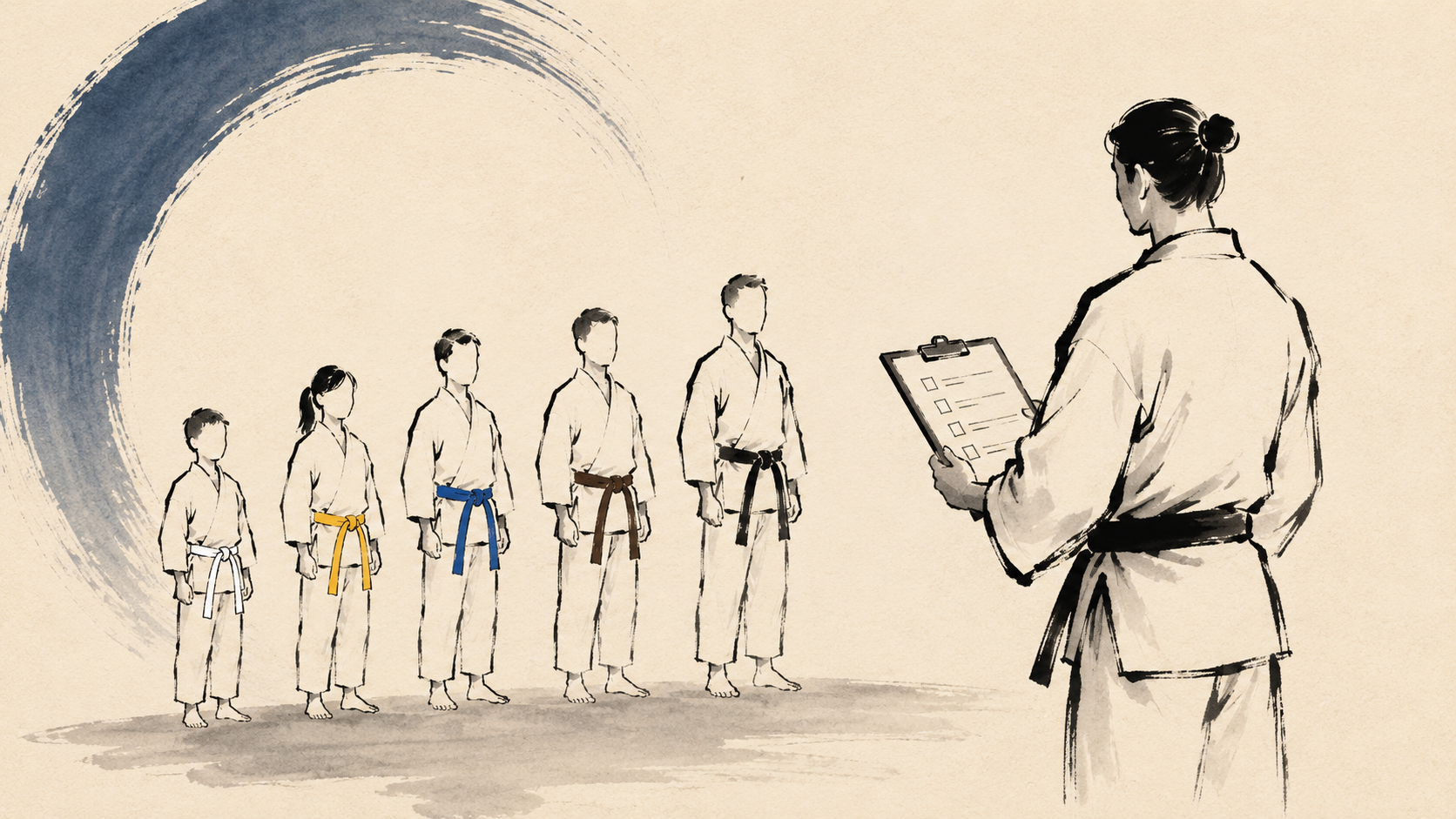
Belt gradings are among the most important moments in the life of a martial arts or combat sports club. Whether you practice judo, karate, taekwondo, aikido, Brazilian jiu-jitsu, kung fu, krav maga, kickboxing or any other discipline, a rank represents far more than a simple belt, level or color.
Read article →

The global explosion of Brazilian Jiu-Jitsu (BJJ): why everyone is taking it up
Over the past decade, Brazilian Jiu-Jitsu (BJJ) has seen spectacular growth around the world. Long a niche discipline reserved for insiders, it has become one of the most widely practiced martial arts, alongside MMA, judo and karate. But how do we explain this BJJ explosion? Why does it attract so many practitioners, from beginners to professional athletes? A look at a global phenomenon.
Read article →